 Stardew Valley
 All Farm Types in Stardew Valley: How to Choose the Best One
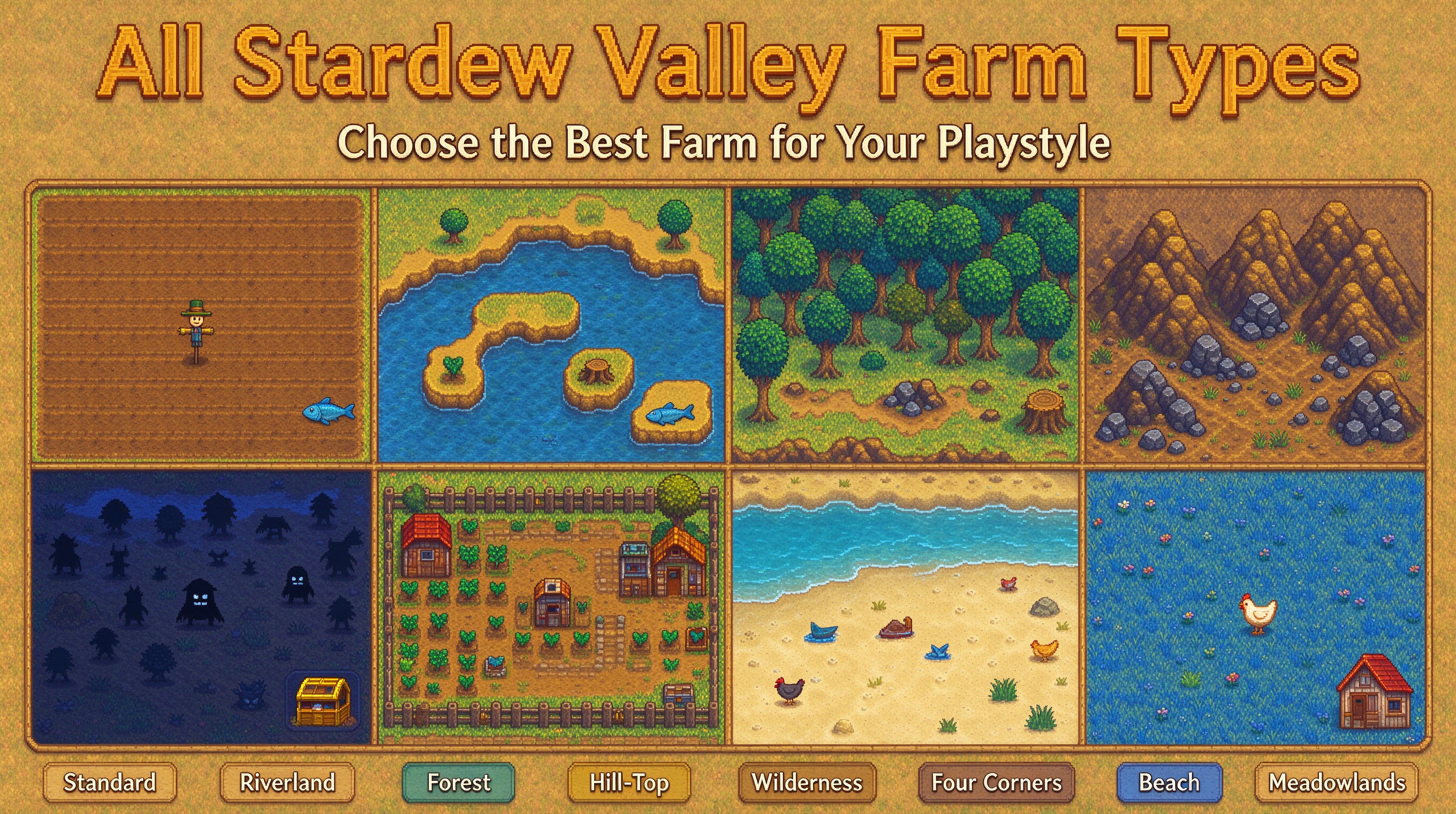
Stardew Valley features eight unique farm maps for players to choose from at the start of a new save. Each farm type comes with exclusive terrain features, gameplay bonuses, pros and cons, and ideal playstyles. Once selected, the farm map cannot be changed for that playthrough, making your initial choice extremely important for long-term progression, farming efficiency, and build planning. This complete guide breaks down every farm type to help you pick the perfect layout for your playstyle.
Standard Farm
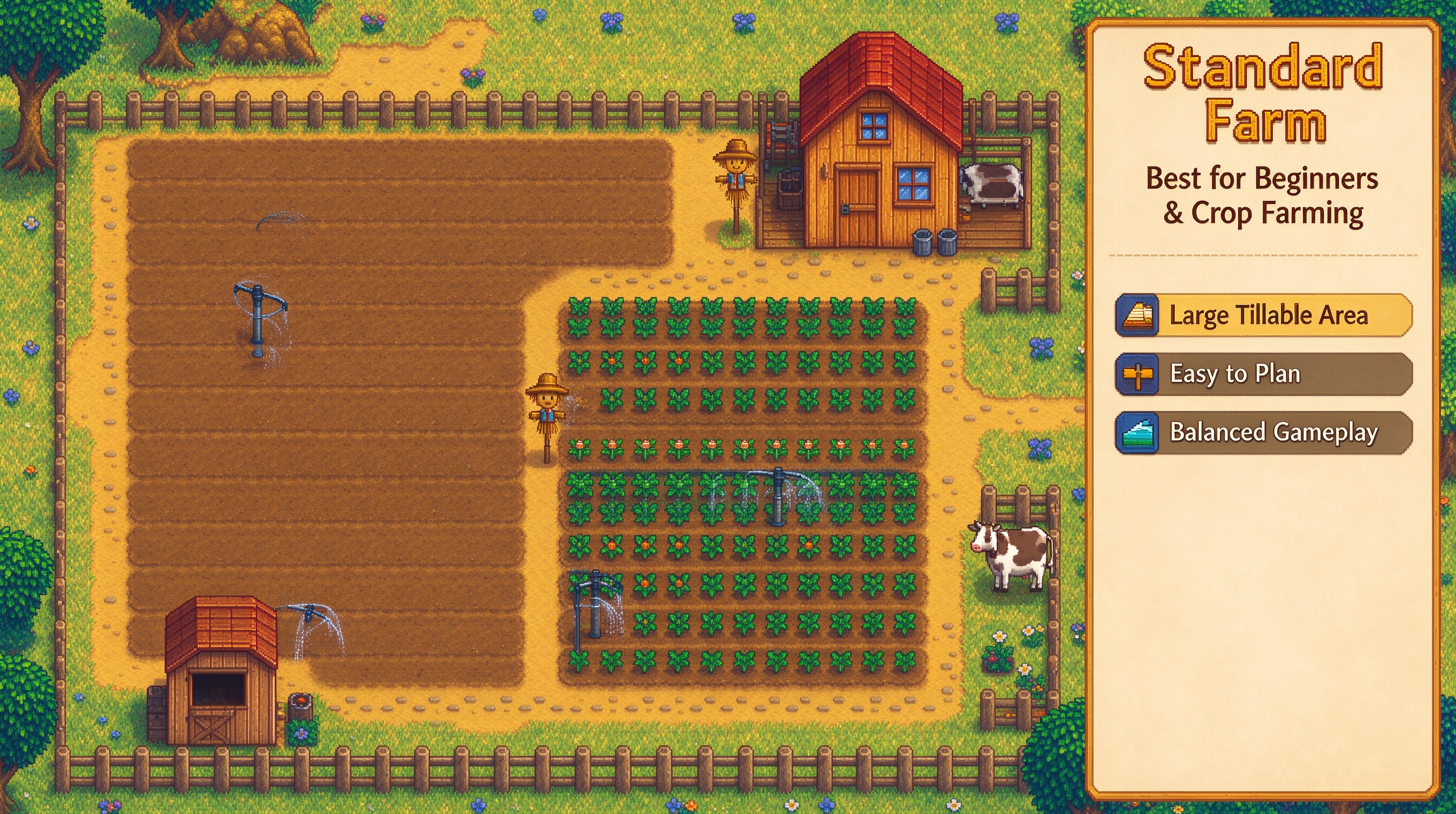
Best For: Beginners, crop-focused players, and general balanced gameplay
The Standard Farm is the default and most beginner-friendly map in Stardew Valley. It offers the largest flat tillable area with almost no obstructive terrain, giving players maximum flexibility for crop planting, building placement, and automated sprinkler setups. With a clean, open layout, it supports every playstyle from crop farming and animal husbandry to casual crafting and decorating.
Pros
- Maximum tillable space for large-scale crop farming
- Flat terrain makes farm planning and automation extremely easy
- No unique penalties or restrictive mechanics
- Perfect for learning core game mechanics for new players
Cons
- No special gameplay bonuses or unique resource spawns
- Playstyle is generic with no specialized advantages
Recommended Layout: Divide the farm into dedicated crop zones, animal barn areas, and crafting zones. Place your greenhouse near the farmhouse for easy daily access, and reserve outer areas for tree planting and decorative pathways.
Riverland Farm
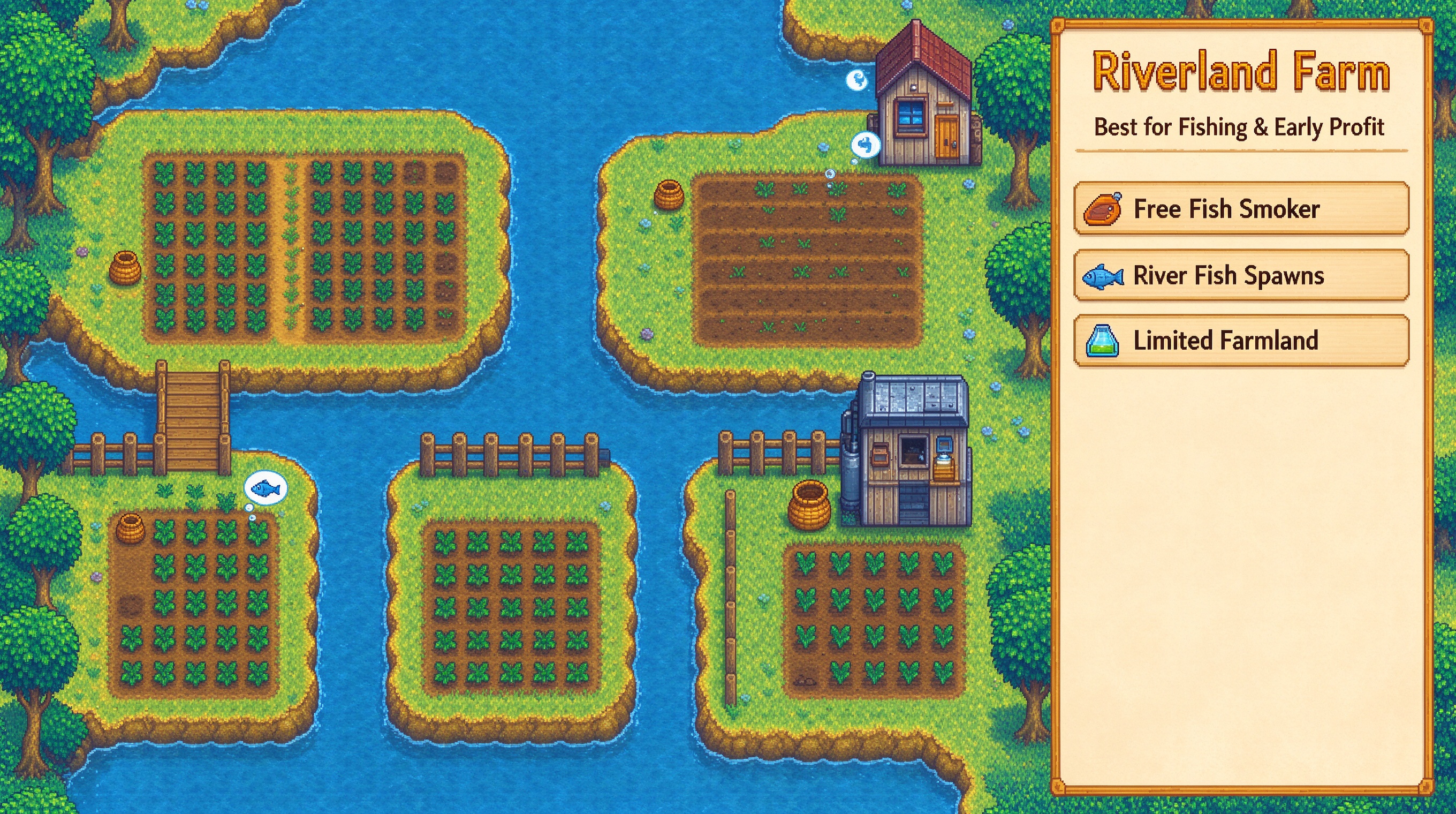
Best For: Fishing-focused players, early-game profit builds
Riverland Farm is a water-dominated map split into multiple small island sections. This farm is specifically designed for fishing gameplay, featuring natural river spawns, frequent fishing bubble spots, and a free Fish Smoker at the start of the game. Fish smoked with the smoker sell for double the original price, creating an incredible early-game income advantage.
Pros
- Starts with a free Fish Smoker for high-value fish processing
- High river fish spawn rate and frequent fishing bubbles
- Perfect for leveling fishing skill rapidly
- Excellent early-game money source before crop maturation
Cons
- Very limited tillable farmland due to large water coverage
- Scattered land areas make large crop layouts impossible
- Fallen trees often drop into water and become uncollectable
Recommended Layout: Use small flat land patches for essential crops and animal buildings. Focus most of your early gameplay on fishing and smoked fish sales, and reserve limited land for high-value seasonal crops only.
Forest Farm
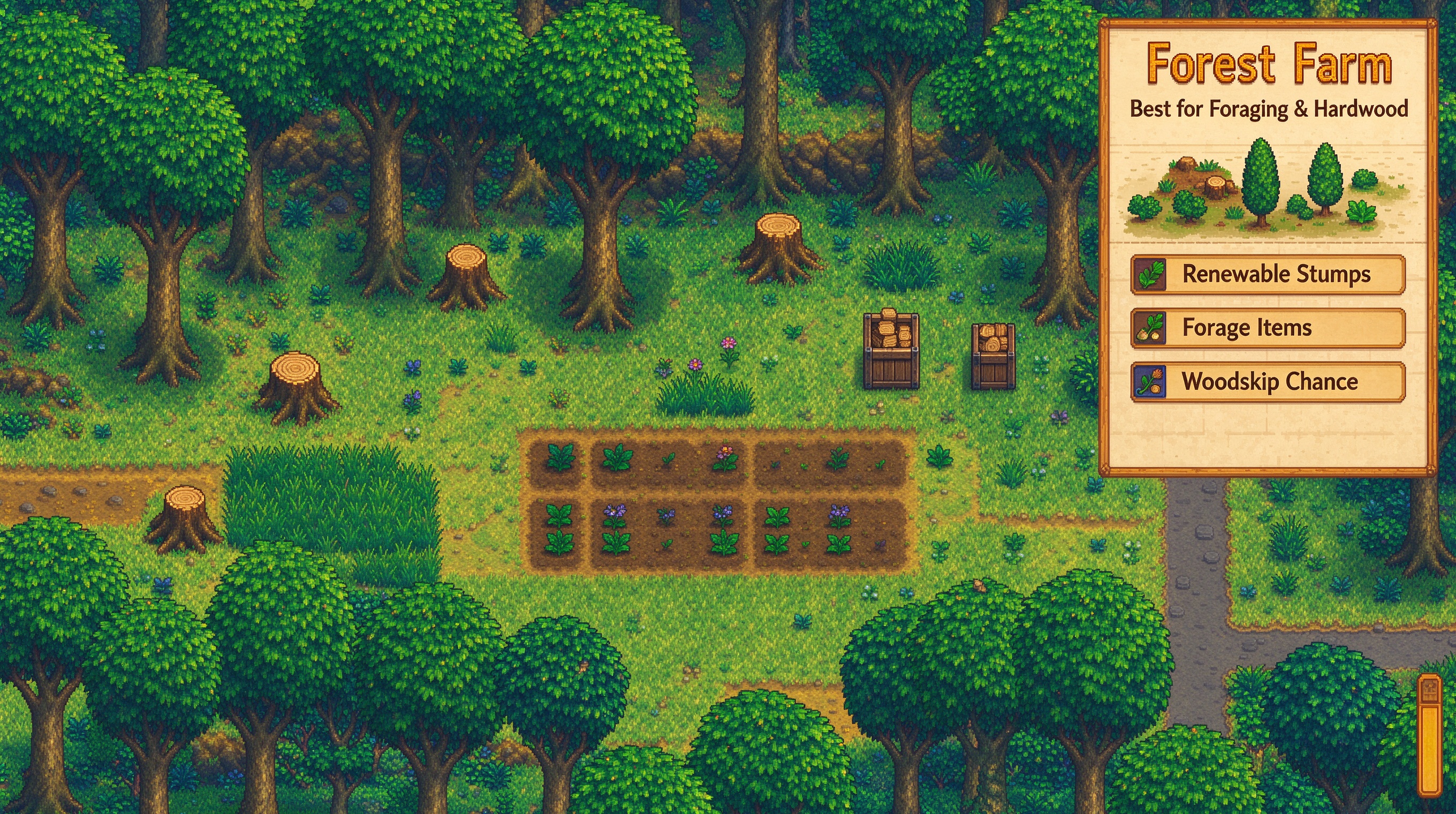
Best For: Foraging, hardwood farming, resource collectors
Forest Farm prioritizes foraging and resource gathering. The map spawns renewable large stumps daily, providing a steady source of hardwood throughout early and mid-game. It also features abundant seasonal forage items, mixed seeds, and natural forest terrain that encourages exploration and foraging skill progression. Players also have a small chance to catch Woodskip fish normally found only in the Secret Woods.
Pros
- Daily renewable hardwood stumps for unlimited hardwood supply
- Plentiful seasonal forage items for bundles and profit
- Unique Woodskip fish spawn chance
- Natural forest aesthetic perfect for decorative farm builds
Cons
- One of the smallest tillable areas among all farm types
- Many initial stumps require upgraded axes to clear
- Irregular terrain complicates large-scale automation
Recommended Layout: Preserve forest zones for daily hardwood and forage spawns. Concentrate crop fields and animal housing in the few large open clearings to maximize limited usable space.
Hill-Top Farm
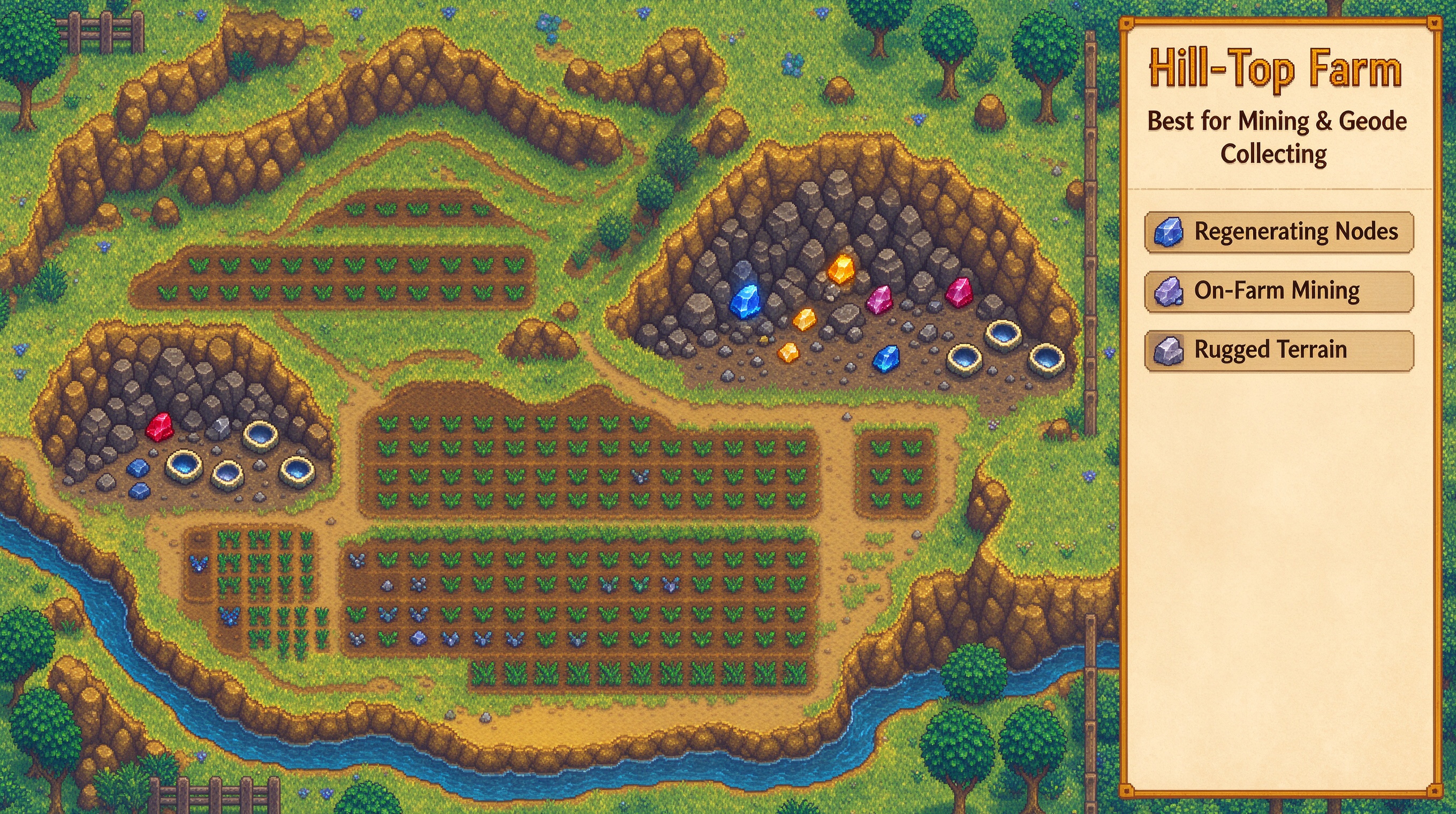
Best For: Mining-focused players, geode and ore collectors
Hill-Top Farm is built for mining enthusiasts. The rocky terrain naturally spawns stones, ore nodes, and geodes that regenerate every few days, providing consistent mining resources without traveling to the mines. The map features elevated cliffs and winding streams that split farmland into segmented zones, creating a rugged, mining-oriented landscape.
Pros
- Natural regenerating ore, stone, and geode nodes on farm terrain
- Convenient on-site mining resource farming
- Balanced forest fish spawn rate for supplementary fishing
Cons
- Cliffs and streams heavily reduce usable farming space
- Large boulders and stumps can block mining zones early-game
- Poor layout for large animal barn complexes
Recommended Layout: Reserve elevated rocky zones for mining node farming. Use lower flat valleys for compact crop fields and essential animal buildings. Prioritize mining progression over massive crop production.
Wilderness Farm
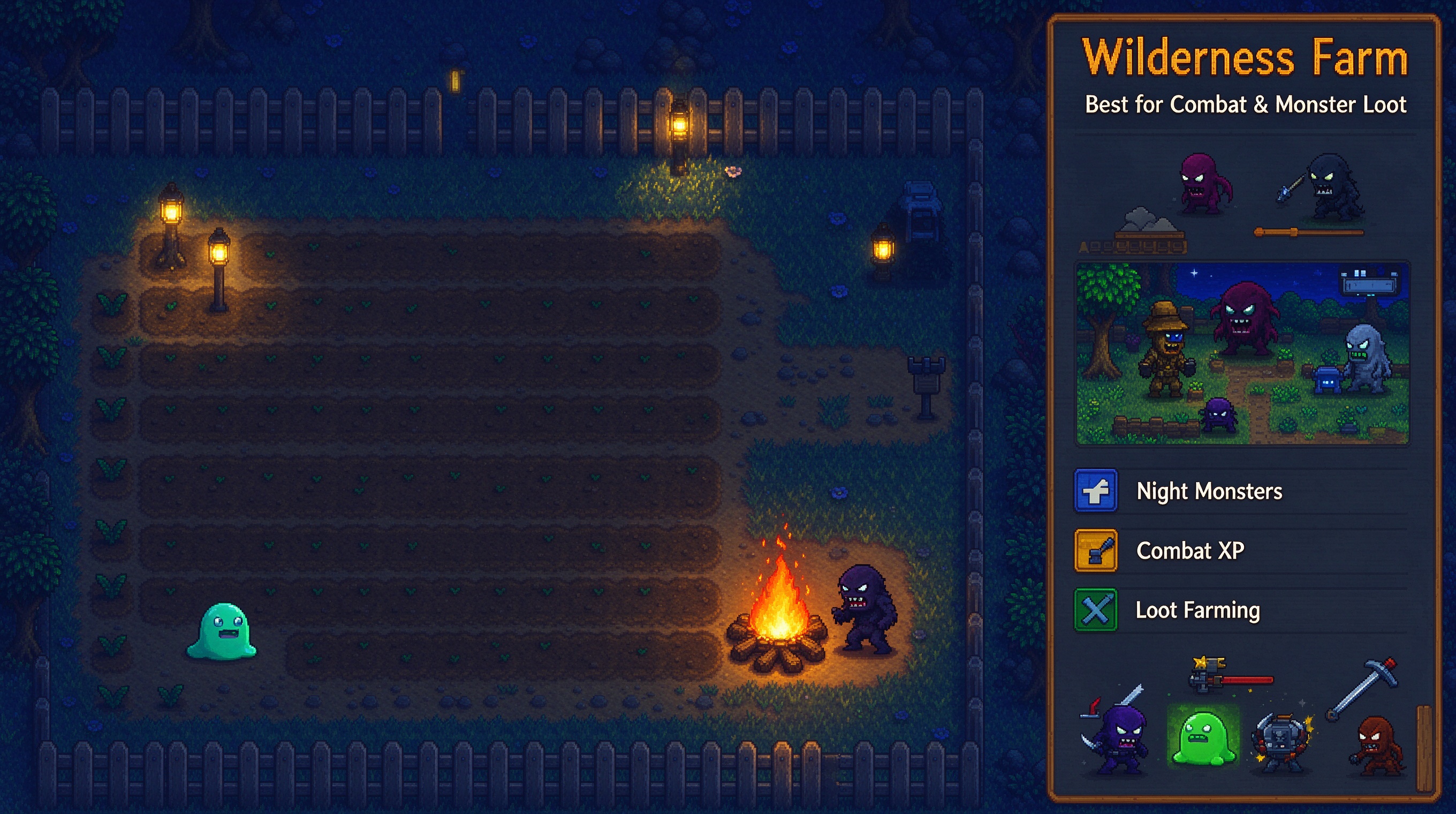
Best For: Combat players, monster farming, adventurous builds
Wilderness Farm blends standard farming space with nighttime monster spawns. This farm scales monster spawn rates based on your combat level, making it ideal for players who want to farm monster drops, gain combat experience, and collect rare loot right on their farm. The terrain is similar to Standard Farm with minor natural obstacles.
Pros
- Nighttime monster spawns for easy combat XP and loot farming
- Large usable land area similar to Standard Farm
- Great for completing monster slayer goals quickly
Cons
- Constant nighttime monster threats require combat preparation
- High trash fishing rate reduces water harvesting efficiency
- Not suitable for casual peaceful gameplay
Recommended Layout: Build slime hutches and combat-related structures in outer farm zones. Keep crop and animal zones centralized and protected with fences and lighting to avoid monster interference.
Four Corners Farm
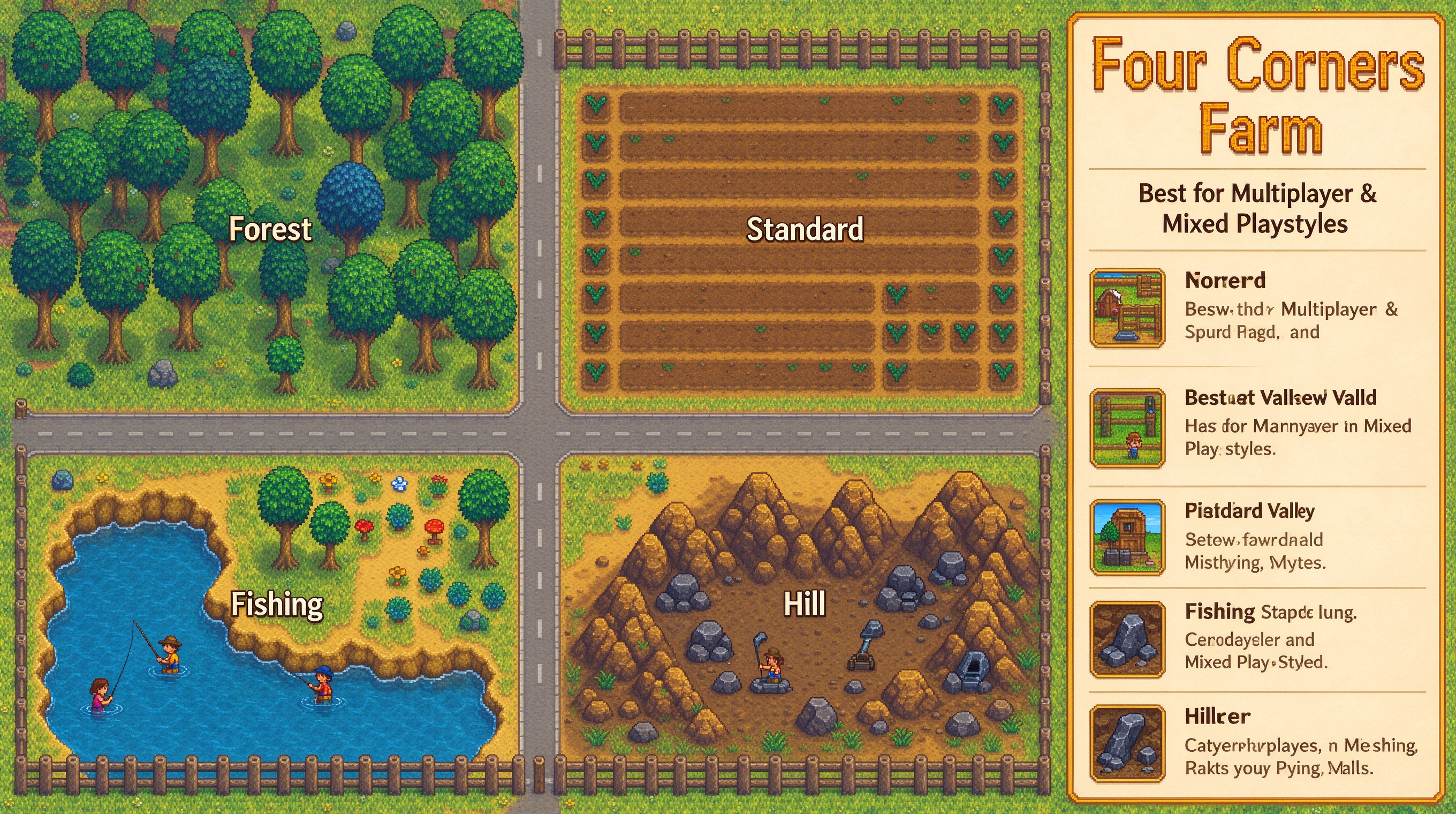
Best For: Multiplayer co-op, mixed playstyles, flexible builds
Four Corners Farm is uniquely divided into four distinct quadrants, each featuring terrain inspired by other farm types. The top-left zone resembles Forest Farm, top-right mimics Standard Farm, bottom-left offers water fishing zones, and bottom-right contains hill-style rocky terrain. This multi-biome design is officially intended for multiplayer co-op gameplay, allowing multiple players to specialize in different professions.
Pros
- Four separated zones perfect for multiplayer player division
- Combines fishing, mining, foraging, and crop farming in one map
- Extremely flexible for mixed hybrid playstyles
Cons
- Segmented terrain prevents unified large-scale farm layouts
- No single specialized bonus compared to dedicated farm types
Recommended Layout: Assign each quadrant a dedicated role: crops, animals, mining, and fishing/foraging. Each player in co-op can manage their own independent zone for organized team progression.
Beach Farm
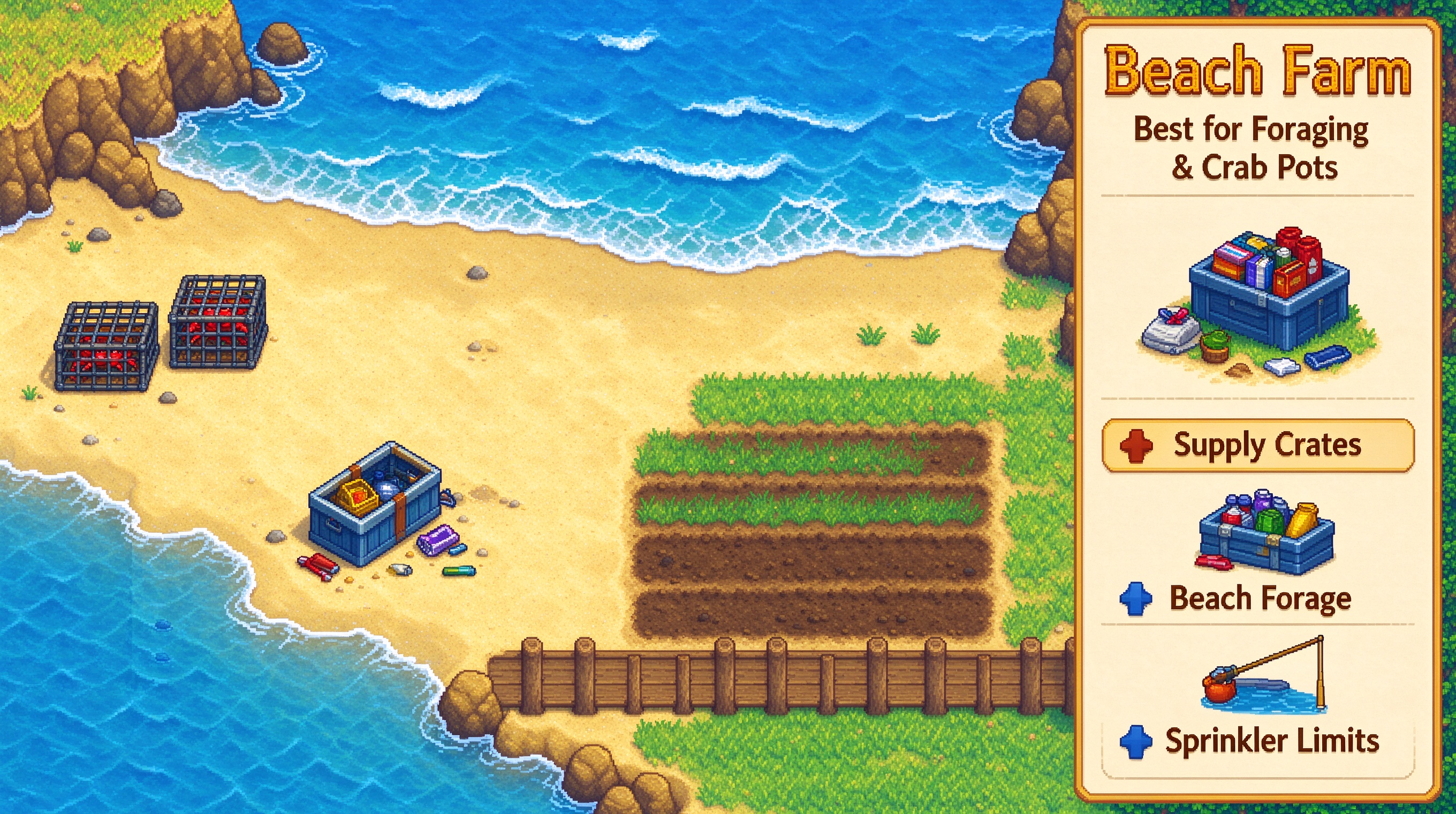
Best For: Foraging, crab pot fishing, aesthetic builds
Beach Farm offers a tropical coastal landscape with unique foraging and fishing mechanics. Ocean supply crates periodically wash ashore with free loot, and the map features abundant beach forage items. The biggest limitation of Beach Farm is sandy soil, which disables sprinkler functionality on most coastal tiles, making automated crop farming extremely challenging.
Pros
- Random shore supply crates provide free resources
- Rich beach foraging and ocean fishing opportunities
- Unique beautiful coastal aesthetic for farm decoration
Cons
- Sandy soil blocks sprinkler usage on most tiles
- Manual watering required for most crop fields
- Not ideal for late-game automated crop economies
Recommended Layout: Place all crop fields on the small non-sandy inland tiles. Fill coastal zones with crab pots and foraging spots. Focus on manual high-value crops and ocean resource farming instead of mass automation.
Meadowlands Farm (1.6 New Farm)
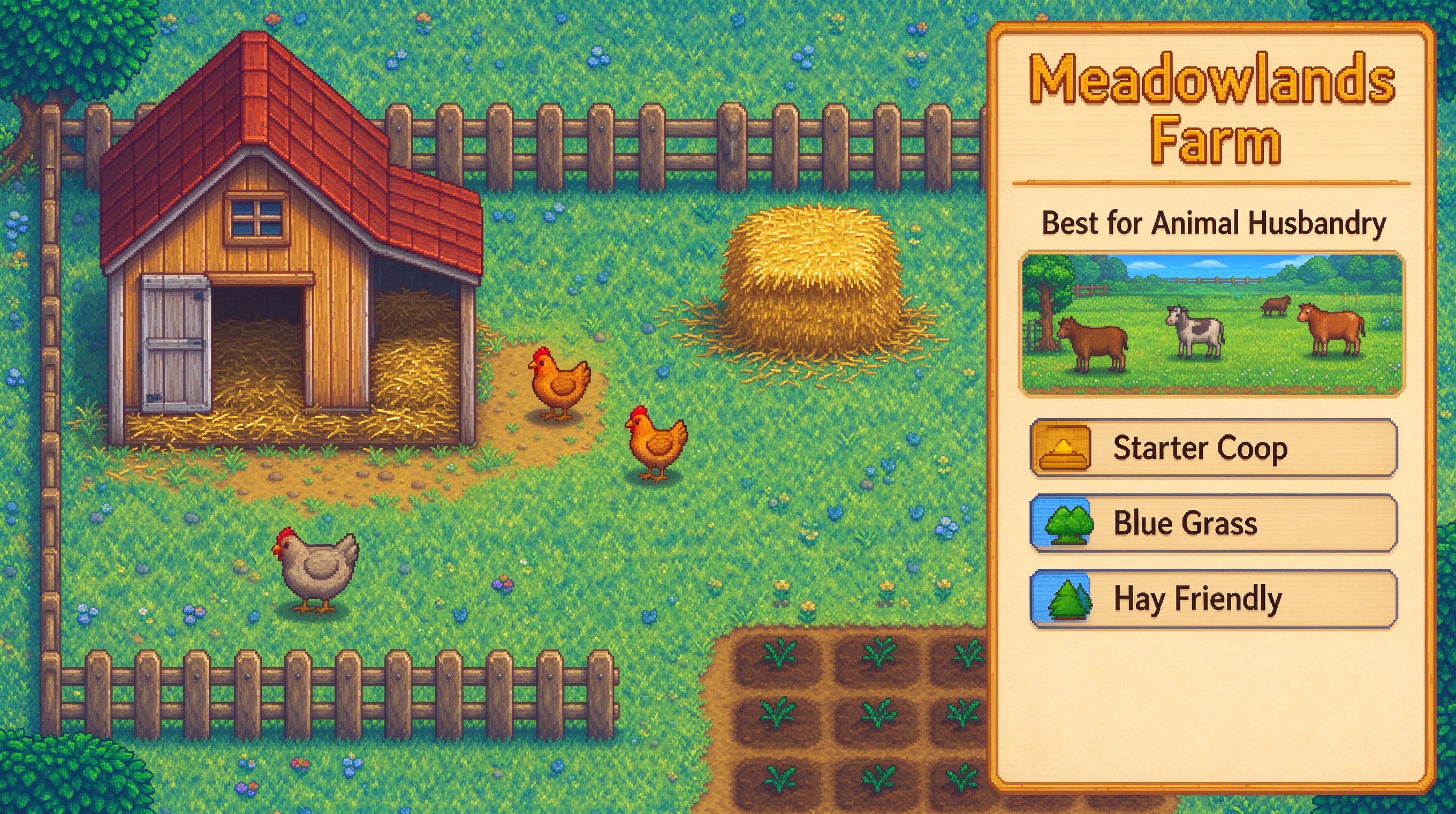
Best For: Animal husbandry, ranching players
Meadowlands Farm is the newest farm type added in the Stardew Valley 1.6 update, specifically designed for animal raising. Players start with a pre-built coop and two chickens, plus extra starting hay instead of parsnip seeds. The map features unique blue grass that animals prefer, encouraging natural grazing and optimal animal growth.
Pros
- Starts with coop + 2 chickens for instant animal farming
- Special blue grass improves animal grazing efficiency
- Extra starting hay removes early animal feeding stress
Cons
- Lower crop soil quality compared to standard farmland
- High trash fishing rate limits water resource usage
- Focused animal design limits general build diversity
Recommended Layout: Dedicate most farm space to barns, coops, and grazing pastures. Reserve small zones for essential seasonal crops to supplement animal-focused income.
How to Choose Your Perfect Farm Type
Pick your farm based on your core playstyle:
- New players / casual farming → Standard Farm
- Fishing main / early profit → Riverland Farm
- Hardwood & foraging farming → Forest Farm
- Mining & geode grinding → Hill-Top Farm
- Combat & monster farming → Wilderness Farm
- Multiplayer co-op → Four Corners Farm
- Aesthetic beach & foraging runs → Beach Farm
- Full animal ranch build → Meadowlands Farm
References
- Stardew Valley Official Wiki
- The Escapist: All Stardew Valley Farm Types
- NameHero Gaming Blog: The 9 Best Stardew Valley Farm Layouts
Original pixel illustrations created for this guide. This is an unofficial fan resource, not affiliated with ConcernedApe.