 Stardew Valley

Stardew Valley 1.6 New Crops Profit Tier List (2026 Updated)
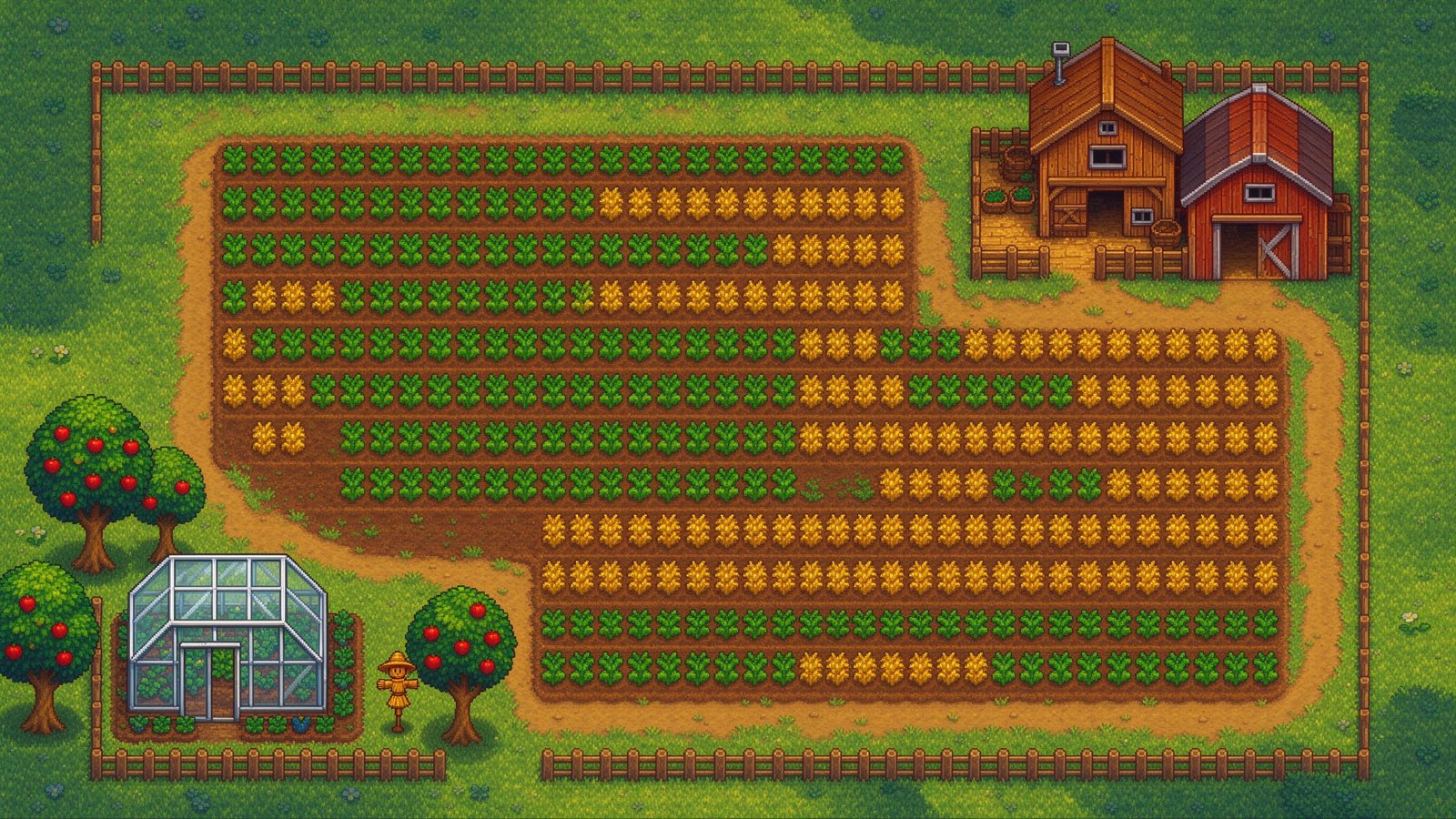
Let’s fix the biggest piece of misinformation about 1.6 first: the update added exactly four new crops. Not eight, not twelve.
Most “1.6 new crops” articles list Amaranth, Sunflower, Garlic, and a pile of other vegetables that have been in the game since 1.0. They’re not new, and any strategy built on that list produces broken math.
The four are:
| Crop | 季节 | Days to first harvest | Regrow | Base sell |
|---|---|---|---|---|
| Carrot | Spring | 3 | No | 35g |
| Summer Squash | Summer | 6 | Every 3 days | 45g |
| Broccoli | Fall | 8 | Every 4 days | 70g |
| Powdermelon | Winter | 7 | No | 60g |
That’s the whole list. Everything below is built on those four.
The Thing Nobody Mentions: You Cannot Buy These Seeds
This is the actual defining feature of the 1.6 crops, and it changes how you use them more than any stat does.
Carrot Seeds, Summer Squash Seeds, Broccoli Seeds, and Powdermelon Seeds are not sold at Pierre’s, not sold at JojaMart, and not sold at the Traveling Cart.
You get them from:
| Source | Notes |
|---|---|
| Seed Spots | The diggable spots that appear around the map |
| Raccoon requests | The raccoon family trades items for rewards |
| Raccoon Wife trade | Carrot = 1 Maple Seed, Summer Squash = 15 Sap, Broccoli = 5 Moss, Powdermelon = 2 Pine Cone |
| Golden Fishing Treasure Chest | Random but frequent if you fish a lot |
| Seed Maker | Turn a harvested crop back into seeds |
| Prize Machine | Ticket rewards |
| Mystery Boxes | 1.6 addition |
| Crates and barrels | In the mines and elsewhere |
| Iridium Golems | Drop chance |
There’s also a seasonal drop window — each seed type only drops during a specific date range:
| Seed | Drop window |
|---|---|
| Carrot Seeds | Winter 21 → Spring 23 |
| Summer Squash Seeds | Spring 24 → Summer 20 |
| Broccoli Seeds | Summer 21 → Fall 20 |
| Powdermelon Seeds | Fall 21 → Winter 20 |
Why this matters practically: you cannot plan “500 Summer Squash this year” the way you plan a blueberry field. Your plantable area is capped by your seed inventory. In Year 1 that means these crops are supplements, not your main income. Your main income still has to come from shop-bought crops.
In Year 2+, once you have a Seed Maker loop running, the constraint loosens — a single Broccoli harvest can be multiplied into a seed supply.
How the Math Works (So You Can Check It Yourself)
Profit-per-day rankings are easy to fake and hard to verify, so here’s the method.
Harvests in a 28-day season, planted on day 1:
- No regrow:
H = floor((28 − 1) ÷ D) - Regrowing:
H = 1 + floor((28 − D − 1) ÷ R)
Where D = days to first harvest, R = regrow interval.
Then: Revenue = H × sell price, and for seed cost we use the seed’s own sell value as opportunity cost — the honest model, since these seeds are a resource you could otherwise sell.
One rule that surprises people: Speed-Gro and the Agriculturist profession speed up first maturity but do not shorten the regrow interval. Fertilizing a Summer Squash plot gets you the first harvest sooner; it does not make it re-fruit faster.
The Four Crops, Ranked
#1 — Summer Squash (Summer, 6 days, regrow 3)
| Metric | Value |
|---|---|
| Seed opportunity cost | 20g |
| Harvests in 28 days | 8 |
| Seasonal revenue | 360g |
| Seed cost | 20g (one seed, regrows) |
| Net per tile | 340g |
| Net per day | 12.14g |
Why it wins: one seed, eight harvests. The regrow cycle is the shortest of the four, and it consumes exactly one seed all season.
Verdict: A-tier. Not comparable to Blueberry on raw volume, but it’s free-ish income from seeds you found while doing something else. Plant every Summer Squash seed you have.
#2 — Broccoli (Fall, 8 days, regrow 4)
| Metric | Value |
|---|---|
| Seed opportunity cost | 40g |
| Harvests in 28 days | 5 |
| Seasonal revenue | 350g |
| Seed cost | 40g |
| Net per tile | 310g |
| Net per day | 11.07g |
Why it’s close to first: 70g per harvest is the highest base price of the four, and it still regrows.
The timing catch: 8 days to first harvest means if you find Broccoli Seeds on, say, Fall 18, you get one harvest at best. Plant it, but don’t count on a full season from late finds.
Verdict: A-tier. Slightly behind Summer Squash on paper, but the higher per-unit price makes it better for Preserves Jar value.
#3 — Carrot (Spring, 3 days, no regrow)
| Metric | Value |
|---|---|
| Seed opportunity cost | 15g |
| Harvests in 28 days | 9 |
| Seasonal revenue | 315g |
| Seed cost | 135g (9 seeds, no regrow) |
| Net per tile | 180g |
| Net per day | 6.43g |
Why it ranks third despite the fastest cycle: no regrow means every harvest costs you a new seed. Nine harvests burn nine seeds. The fast 3-day loop is great for cash flow, terrible for seasonal net.
The hidden use nobody talks about: a Carrot can be fed to your horse to raise its speed for the rest of the day. That’s a real movement buff, not a novelty — it’s worth keeping a stack of Carrots in your bag for long days.
Verdict: B-tier for profit, A-tier for utility. Plant Carrots early in Spring when you need cash this week, and keep some for horse feeding.
#4 — Powdermelon (Winter, 7 days, no regrow)
| Metric | Value |
|---|---|
| Seed opportunity cost | 20g |
| Harvests in 28 days | 3 |
| Seasonal revenue | 180g |
| Seed cost | 60g |
| Net per tile | 120g |
| Net per day | 4.29g |
The real significance isn’t profit — it’s that Winter finally has an outdoor crop. Before 1.6, Winter farming meant greenhouse only. Powdermelon breaks that: it grows in the open in Winter.
It’s also a giant crop — one of only five crops that can form a 3×3 giant version, which yields far more than nine individual melons.
Verdict: C-tier for gold, S-tier for novelty and Winter utility. Plant every one. It’s free field income in a season that previously had none.
Head-to-Head Table
| Crop | 季节 | Harvests | Revenue | Seed cost | Net | Net/day |
|---|---|---|---|---|---|---|
| Summer Squash | Summer | 8 | 360g | 20g | 340g | 12.14 |
| Broccoli | Fall | 5 | 350g | 40g | 310g | 11.07 |
| Carrot | Spring | 9 | 315g | 135g | 180g | 6.43 |
| Powdermelon | Winter | 3 | 180g | 60g | 120g | 4.29 |
Do These Beat the Season Benchmarks?
Honest answer: no — and that’s fine.
| 季节 | Benchmark crop | New crop verdict |
|---|---|---|
| Spring | Parsnip (35g, 4 days, 20g seed) / Strawberry (120g, regrow 4) | Carrot is a side dish, not a replacement |
| Summer | Blueberry (multi-berry regrow) | Summer Squash is a supplement |
| Fall | Pumpkin (320g, 13 days, 100g seed) | Broccoli is a supplement |
| Winter | Nothing existed | Powdermelon is genuinely new capability |
The correct way to use them: they’re not your income. They’re bonus yield from land you were already watering and seeds you found for free. Reframe them that way and they stop feeling underwhelming.
The one true strategic win is Powdermelon — Winter field income didn’t exist before.
Processing: Keg or Preserves Jar?
For low-value crops, this decision matters more than raw price.
The general rule: Kegs (wine/juice) multiply base value by 3× for fruit and 2.25× for vegetables, but take far longer than Preserves Jars. A Jar (pickles/jelly) multiplies by 2× but finishes in a fraction of the Keg’s time.
| Machine | Multiplier | Time |
|---|---|---|
| Keg — wine (fruit) | 3× | long |
| Keg — juice (vegetable) | 2.25× | long |
| Preserves Jar | 2× | short |
For the 1.6 crops specifically: their base values are low (35g–70g), so the absolute gold difference between a Keg and a Jar is small. That means machine time decides it — and the Jar wins, because a Keg occupied for a long cycle on a 45g vegetable is a Keg not making 1,650g wine from Ancient Fruit.
The rule to remember: never park a Keg on a cheap crop once you have Ancient Fruit or Starfruit. Use Jars for the cheap crops, Kegs for the expensive ones.
What to Actually Do
If you just started (Year 1)
- Collect every seed you find. Seed spots, mystery boxes, crates — don’t skip them.
- Plant them, but don’t build your season around them. Your income stays Parsnip/Potato/Strawberry in Spring, Blueberry in Summer, Pumpkin/Cranberry in Fall.
- Never sell the last one of a new crop — run it through a Seed Maker first. A Broccoli turned into 2–3 seeds is worth more than the 70g.
- Keep Carrots for the horse.
If you’re in Year 2+
- Seed Maker loop: harvest → seed maker → replant. This is how you break the “seeds aren’t sold” constraint.
- Powdermelon every Winter. Free field income where there used to be none.
- Raccoon Wife trades are cheap. 15 Sap for a Summer Squash seed, 5 Moss for Broccoli, 2 Pine Cone for Powdermelon — that’s a favorable trade by any measure. Check the trade list regularly.
- Don’t plant these in the greenhouse. Greenhouse space belongs to Ancient Fruit or Starfruit. A 45g vegetable in a 1,650g bottle slot is a loss.
Common Mistakes
1. Believing there are 12 new crops. There are 4. Any guide listing Amaranth or Sunflower as “new in 1.6” is wrong — those are 1.0 crops.
2. Assuming Powdermelon regrows. It doesn’t. 7 days, one harvest, then replant.
3. Thinking Speed-Gro speeds up regrowth. It only accelerates first maturity. Regrow interval is fixed.
4. Planning a field you can’t seed. No shop sells these seeds. If you have 6 seeds, you plant 6 tiles.
5. Putting them in the greenhouse. Wrong use of the most valuable tiles on your farm.
6. Kegging a 45g crop when Ancient Fruit exists. Spreadsheet-legal, economically wrong.
Summary
The 1.6 crops are a scavenging economy, not a farming strategy.
- Only four exist: Carrot, Summer Squash, Broccoli, Powdermelon
- Seeds are not sold — you find them, trade for them, or multiply them in a Seed Maker
- Summer Squash is the best raw earner (12.14g/tile/day)
- Powdermelon is the biggest strategic addition, because Winter previously had no outdoor crop
- Carrot is the best utility crop — fast cash, and horse speed
- Broccoli sits between: high unit price, slightly slower cycle
Plant what you find, multiply it with a Seed Maker, keep the greenhouse for Ancient Fruit, and treat these four as bonus rather than backbone.
For the greenhouse plan that actually makes money, see Best Greenhouse Layout. For seed economy and fast cash in Spring, see Fall Year 1 Million Gold.